Landlord 1099 Requirements: Who to Report and How

If you pay an independent contractor $2,000 or more for rental-related work in 2026, you must issue Form 1099-NEC by January 31 of the following year. If you're a property manager paying an owner $600 or more in collected rents, you generally owe them a Form 1099-MISC. Those two rules cover most landlord 1099 requirements, but the details around thresholds, exceptions, and payment types trip up even experienced owners.
Here's what governs the decision:
- Form 1099-NEC covers payments to unincorporated contractors and vendors for services performed in your rental business. The threshold for tax year 2026 is $2,000, up from the longstanding $600 mark.
- Form 1099-MISC covers rents and certain other payments, generally at the $600 threshold.
- Form W-9 is how you collect the taxpayer identification number you'll need before either form gets filed.
- Both furnishing to the recipient and filing with the IRS are due by January 31.
Miss one of these and you're not just facing a paperwork headache. You're opening the door to penalties and, in some cases, personal liability for unpaid backup withholding.
Key Takeaways
Meeting landlord 1099 requirements comes down to tracking who you pay, how much, and by which method, then filing Form 1099-NEC or 1099-MISC before the January 31 deadline.
| Point | Details |
|---|---|
| Know the 2026 threshold | Form 1099-NEC now applies at $2,000 for nonemployee compensation, up from the old $600 mark. |
| Match the form to the payment | Use 1099-NEC for contractor services and 1099-MISC for rents of $600 or more. |
| Collect W-9s before paying | Get a signed Form W-9 from every vendor before the first check goes out, not at year-end. |
| Watch the January 31 deadline | Furnish recipient copies and file with the IRS by January 31 for Form 1099-NEC. |
| Consider managed compliance | Milwaukeepm coordinates vendor W-9 collection and consolidated owner reporting to reduce filing errors. |
Table of Contents
- Who Must Receive a 1099 From a Landlord
- Which 1099 Form to Use and the 2026 Threshold Change
- How to Count Payments and Handle Payment Processors
- Collecting TINs and Handling Backup Withholding
- Special Situations Landlords Commonly Ask About
- How to File, Deadlines, and Penalties for Getting It Wrong
- A One-Page Compliance Checklist for Landlords
- Sources
Who Must Receive a 1099 From a Landlord
The trigger isn't just "I paid someone." It's who you paid, what for, and how much.
Independent contractors and unincorporated vendors who perform services tied to your rental business are the most common recipients. That includes plumbers, handymen, landscapers, and cleaning crews who work as sole proprietors or through an LLC that hasn't elected corporate tax status. If a general contractor invoices you $3,500 for a bathroom remodel at your rental unit, that person needs a 1099-NEC.
Landlords occasionally end up on the other side of this, too. If your tenant is a business and pays rent that flows through a management arrangement, or if you're the one collecting rent on someone else's behalf, a 1099-MISC obligation can apply for rents of $600 or more, depending on the payer's trade-or-business status.
A few exceptions matter just as much as the rule itself:
- Payments to corporations are typically exempt, with attorneys being a notable exception.
- Repairs to your own personal residence, unrelated to your rental business, don't count toward any threshold.
- Payments made by credit card or through a third-party platform like a rent collection app shift the reporting duty to the processor in most cases.
Property managers occupy a different position entirely. If you hire one to collect rent and remit your net proceeds, the manager, not your tenant, typically carries the 1099 filing obligation to you as the owner.
Which 1099 Form to Use and the 2026 Threshold Change
Choosing between 1099-NEC and 1099-MISC comes down to one question: are you paying for a service, or are you paying rent?
Form 1099-NEC is for nonemployee compensation, meaning labor and services performed by contractors in your rental business. The 2026 threshold sits at $2,000, a meaningful jump from the $600 figure that had applied for decades. That change means fewer small jobs will trigger a filing requirement, but any contractor relationship that crosses $2,000 for the year still needs one.
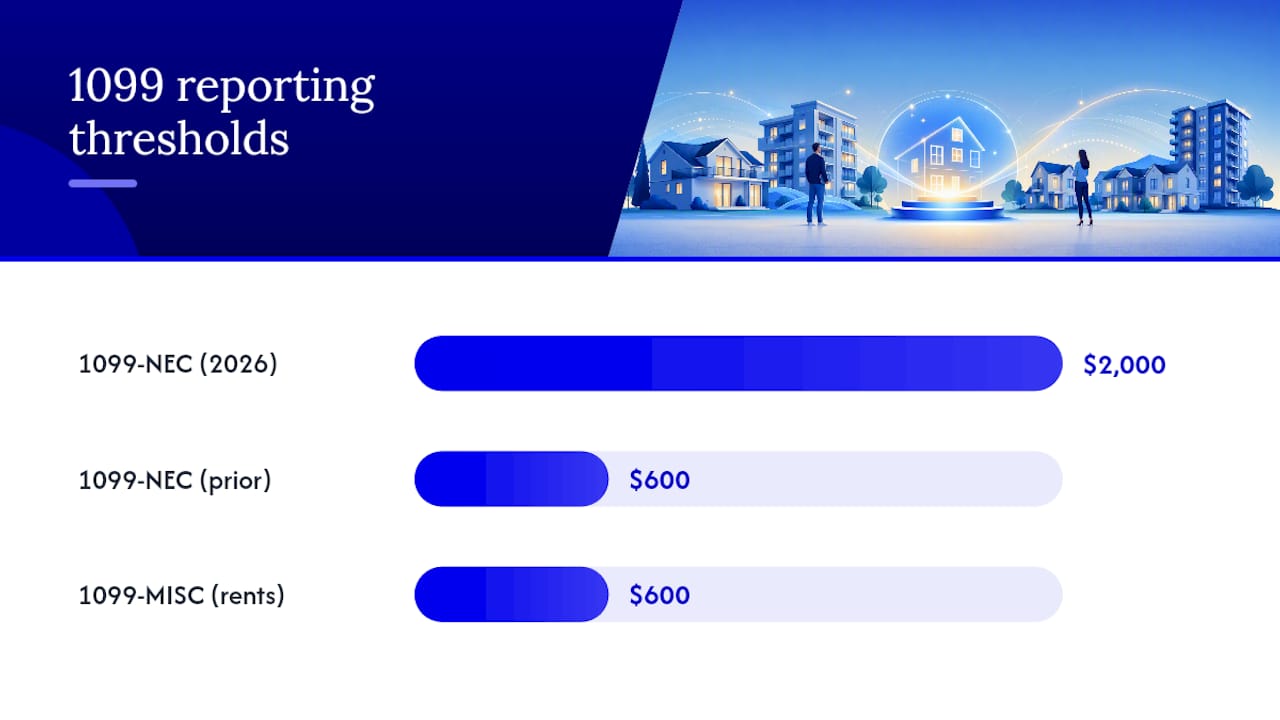
Form 1099-MISC handles rents and a handful of other payment categories, generally at the $600 threshold when the payer is engaged in a trade or business. This form matters most to landlords who rent commercial space to a business tenant, or to property managers disbursing owner proceeds.
A couple of special rules deserve attention:
- Payments to attorneys for legal services are reportable even when the attorney operates as a corporation, an exception to the usual corporate exemption.
- Corporate payees are otherwise generally excluded, but always confirm entity status on the W-9 before assuming an exemption applies.
Both forms share the same January 31 furnish-and-file deadline, so there's no calendar advantage to picking one over the other.
How to Count Payments and Handle Payment Processors
The IRS doesn't care how many separate checks you wrote. It cares about the total you paid one contractor over the course of the year, so aggregate every payment to the same vendor before checking it against the threshold. Four separate $600 invoices to the same handyman add up to $2,400, which crosses the 2026 line for 1099-NEC.
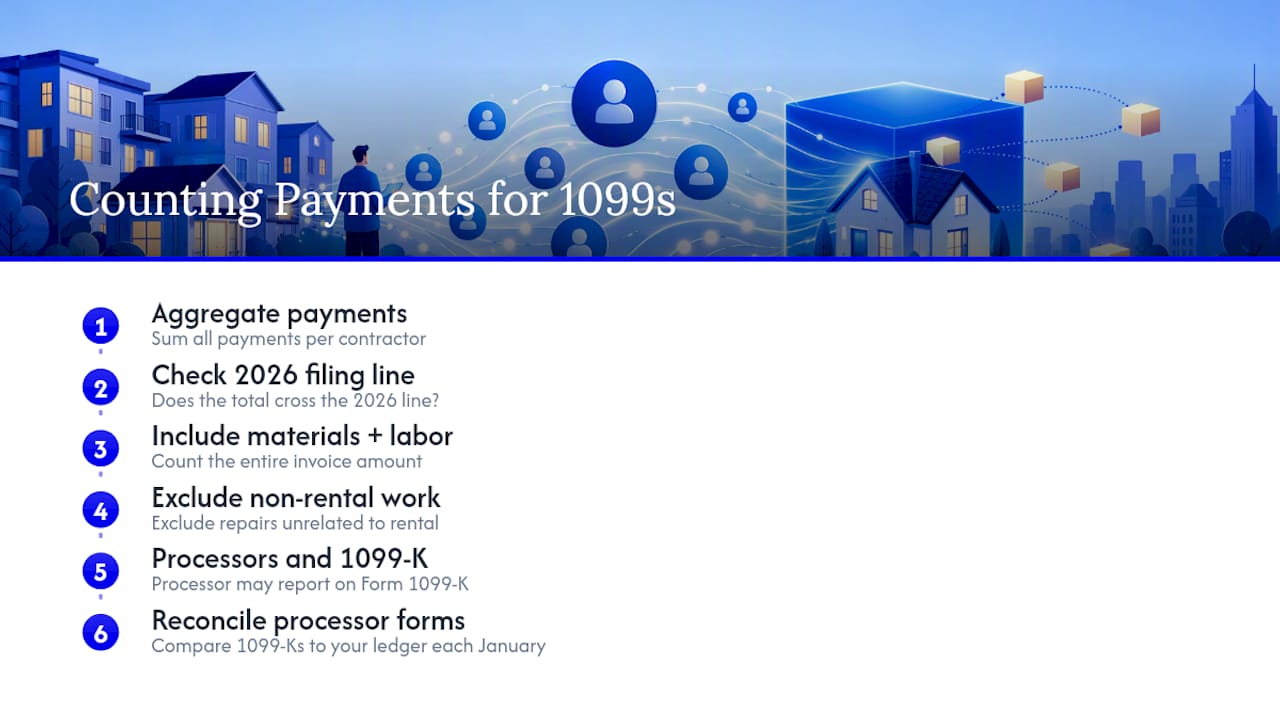
When a contractor bills you for materials and labor together, count the whole invoice. The IRS doesn't split out parts from service time for reporting purposes. What you should exclude is anything unrelated to your rental activity, like a repair at your own home that has nothing to do with a tenant-occupied property.
Payment processors add a wrinkle. If you pay contractors through a card or a platform like a rent collection app, that transaction volume may be reported by the processor on Form 1099-K instead of by you, and current IRS rules require both a dollar and transaction-count threshold to be met before that processor is obligated to issue one, per industry guidance on landlord tax obligations.
Pro Tip: Cross-check every processor-issued 1099-K against your own ledger each January. Processors sometimes report gross transaction volume that includes refunds or reversed charges, and you don't want to double-report income that never actually landed in your account.
Collecting TINs and Handling Backup Withholding
Every contractor you might need to report should hand you a completed Form W-9 before you cut the first check, not after the year closes and you're scrambling for a tax ID number.
Follow this sequence to stay covered:
- Request a signed W-9 from any vendor or contractor before the first payment.
- File the W-9 alongside that contractor's invoices and payment records for the tax year.
- Verify the name and TIN match what's on file; mismatches are the most common cause of IRS notices.
- If a contractor refuses to provide a TIN, or the IRS notifies you the one on file is incorrect, you're required to begin backup withholding at 24% and remit it to the IRS.
- Document every step you took to request the correct TIN. That paper trail is your defense if the IRS later questions your compliance.
Pro Tip: Log the date you received each W-9 next to the corresponding invoice. When tax season arrives, you'll spend minutes instead of hours reconstructing who you paid and whether you have the paperwork to back it up.
Special Situations Landlords Commonly Ask About
A handful of scenarios generate most of the confusion around landlord 1099 requirements, and they're worth addressing directly.
Property managers who collect rent on your behalf and then pass along your net proceeds are treated as the payer to you, the owner. An IRS information letter on property manager reporting confirms that a manager disbursing $600 or more in net rents to an owner generally must issue that owner a 1099-MISC.
When a manager sits between you and your tenants, the reporting chain shifts. The manager reports to you; you don't separately report the rent your tenants paid into that arrangement.
Attorneys remain the standout exception to the corporate exemption. Pay a law firm for eviction proceedings or lease review, and that payment is reportable even if the firm is incorporated. Corporate payees are otherwise usually off the hook, but confirm entity type on the W-9 rather than assuming. Personal household expenses with no connection to your rental business never count toward any 1099 threshold, no matter how large.
How to File, Deadlines, and Penalties for Getting It Wrong
Filing itself is straightforward once you've collected the right paperwork.
- Prepare recipient copies for every contractor or owner who crossed the threshold.
- File with the IRS either on paper or through e-file, checking whether your state has a separate filing requirement.
- Furnish and file Form 1099-NEC by January 31 following the tax year, the same deadline that applies to both the recipient copy and the IRS copy.
- Confirm your total returns for the year against current e-filing thresholds, since filing multiple information returns on paper is increasingly restricted.
The IRS sets January 31 as the hard deadline for both furnishing and filing Form 1099-NEC, and missing it triggers escalating penalties based on how late the correction comes.
Penalties scale with how long you wait to correct a missing or incorrect form, and failing to backup withhold when required can leave you personally liable for the uncollected tax, plus interest.
Pro Tip: Set a recurring calendar reminder for mid-January, not January 30. That gives you a buffer to chase down a missing W-9 before the deadline actually hits.
A One-Page Compliance Checklist for Landlords
Keep this list somewhere you'll actually see it, whether that's a spreadsheet tab or a printed sheet taped inside a filing cabinet.
- Collect a signed W-9 from every contractor and vendor before the first payment.
- Tag each invoice with the property address and job type as it comes in.
- Aggregate payments to each contractor quarterly so you're not surprised in January.
- Flag any payments routed through a card processor or rent collection platform separately.
- Calendar January 31 for both furnishing and filing Form 1099-NEC and 1099-MISC.
- Run a TIN and backup withholding review each December, before the crunch hits.
Pro Tip: Keep one ledger per tax year, organized by property, and link every vendor file to it. Whether you self-manage or work with a property manager, that single habit eliminates most year-end scrambling.
A Property Management Perspective on 1099 Pitfalls
Most 1099 errors we see stem from vendor payments made in month three and forgotten by December. Consolidating vendor payments through an owner portal and collecting W-9s upfront closes that gap. For anything involving worker classification or a corporate payee exception, loop in a tax professional before you file.
Let Milwaukeepm Handle Your Vendor Paperwork
Chasing down W-9s from six different contractors while also managing tenant turnover is exactly the kind of split focus that leads to a missed January 31 deadline. Milwaukeepm coordinates vendor payments, collects and stores contractor tax documents, and delivers consolidated owner reporting through a dedicated portal, so the 1099 paperwork never becomes an afterthought squeezed in between maintenance calls.
Our property management services fold vendor coordination and owner reporting into the same monthly workflow that already handles rent collection, maintenance, and tenant communication. If you're managing a rental in the Milwaukee area and want the 1099 tracking handled alongside everything else, reach out to Milwaukeepm to see how a managed vendor process could fit your properties.
Sources
Check these primary IRS sources before filing: Form 1099-NEC and 1099-MISC instructions, Form W-9, Publication 1099, and Publication 527 on rental property.
When your situation involves worker classification or an unusual payee type, these forms answer most questions, but a tax professional should resolve the rest.
This article is general information, not a substitute for advice from a qualified financial advisor. Consult a qualified financial professional about your own circumstances before acting on anything here.
- Instructions for Forms 1099-MISC and 1099-NEC