When to Hire a Property Manager: A Landlord's Decision Guide

If you own rental property and managing it is eating your evenings, the answer is almost certainly yes: hire a property manager. The clearer question is when and at what cost. Most owners reach the tipping point around five or more units, or the moment their property sits more than 30 minutes away. Professional management typically runs 8%–12% of monthly rent plus leasing and transactional fees, and for most landlords, that fee buys back time worth more than the cost. Before you read further, take three steps right now:
- Run a time-value check. Multiply your hours per month managing the property by what your time is worth per hour. If that number exceeds the monthly management fee, delegation likely improves your net position.
- List the three tasks you most want off your plate. Tenant calls at midnight, lease renewals, or chasing late rent — knowing your pain points clarifies what to outsource first.
- Flag urgent situations. Out-of-state ownership, five or more units, or properties in affordable-housing or rent-controlled programs are signals to move quickly.
Key Takeaways
Hiring a property manager is a business decision that pays off when the cost of your time and risk exceeds the management fee, typically at five or more units, out-of-state ownership, or after one high-cost tenant failure.
| Point | Details |
|---|---|
| Hire trigger: unit count | Most owners benefit from professional management at five or more units or with out-of-state properties. |
| All-in fee reality | Monthly fees of 8%–12% plus leasing and transactional costs often total 15%–17% of gross annual rent. |
| Top three interview questions | Ask for DOM data, a sample owner statement, and a written 30-day takeover plan before signing. |
| Must-have contract clauses | Require explicit scope of work, a vendor spending limit, and a 30-day termination notice with no penalty for cause. |
| KPIs to monitor post-hire | Track vacancy rate, rent collection rate, and average days on market every month. |
| Milwaukeepm | Offers full-service management with a first-year tenant guarantee, owner portal, and eviction coordination through legal partners. |
Table of Contents
- What does a property manager actually do?
- Hiring vs. self-managing: the real trade-offs
- When should you hire a property manager?
- How much does it cost to hire a property manager?
- How do you find and vet a property manager?
- How do you manage the manager after you hire?
- What a high-quality full-service manager should deliver
- An editorial perspective on when hiring actually makes sense
- Milwaukeepm: full-service management without the guesswork
- Sources
What does a property manager actually do?
A property manager's core responsibilities span the full rental lifecycle, from the day a unit goes vacant to the day a tenant moves out. Here is what that looks like in practice:
- Marketing and listing: Syndicate vacancies across rental platforms, set competitive rents based on current market data, and schedule showings.
- Applicant screening: Run credit, background, income, and rental-history checks against written criteria that comply with fair housing law.
- Lease administration: Draft, execute, and renew leases; enforce lease terms; issue notices.
- Rent collection and accounting: Collect rent through online portals, drop boxes, or in-person; process late fees; produce monthly owner statements.
- Maintenance coordination: Triage repair requests, dispatch vetted vendors, track work orders, and conduct periodic inspections.
- Legal and eviction coordination: File eviction paperwork with legal partners when necessary and manage the process through to resolution.
- Owner reporting: Deliver monthly financial statements, maintenance logs, and KPI summaries so you can track performance without being in the weeds.
The daily task load is heavier than most new landlords expect, which is why the first 90 days after hiring a manager matter so much.
What the first 90 days look like
Days 1–30: The manager audits existing leases, photographs the property, sets up the owner and tenant portals, onboards current tenants, and establishes vendor relationships. Expect a lot of information-gathering.
Days 31–60: If a unit is vacant, marketing launches and showings begin. The manager presents qualified applicants for your review (or approves them per your agreed criteria). Maintenance backlogs get addressed.
Days 61–90: Rent collection runs through the new system, the first monthly owner statement arrives, and you begin seeing the reporting cadence you will rely on going forward.
For a single-family home, this process is straightforward. For a six-unit building, the manager may be simultaneously turning one unit, renewing two leases, and fielding maintenance requests from three others — all in the same 30-day window.
Hiring vs. self-managing: the real trade-offs
The financial case is not as simple as "save 10% by doing it yourself." Self-managing can appear cheaper but often costs more over time through longer vacancies, missed maintenance that escalates into expensive repairs, below-market rents set without current data, and the catastrophic cost of a single bad tenant placement.
| Hiring a Manager | Self-Managing |
|---|---|
| Saves about 10 hours per month | Retains 8%–12% of gross rent |
| Insulates you from direct tenant conflict | Keeps you in full control of every decision |
| Reduces legal exposure through documented processes | Requires you to stay current on landlord-tenant law |
| Scales with portfolio growth | Becomes unsustainable past 4–5 units |
| Costs money even in low-maintenance months | Costs time even when nothing goes wrong |
Consider two scenarios. An owner with a single-family rental in their own city, a reliable long-term tenant, and a flexible schedule may genuinely be better off self-managing. The fee savings are real, and the management burden is light. Contrast that with an investor who added a second property two states away: one bad tenant placement, a 60-day eviction, and two months of vacancy can erase a full year of fee savings in a single event.
There is also a liability dimension most owners overlook. When you hire a third-party management firm, the manager operates as an independent contractor rather than your employee. That distinction matters for employer obligations: a resident manager you hire directly can trigger payroll taxes, workers' compensation requirements, and employment-law exposure that a professional management firm does not.
Pro Tip: Before deciding, calculate your break-even vacancy cost. If one extra month of vacancy per year (from slower self-managed leasing) costs more than 12 months of management fees, the fee pays for itself before the manager does anything else.
When should you hire a property manager?
The decision is clearest when at least one of these triggers applies. Work through the checklist below in about 60 seconds.
- Do you own five or more units? At that scale, most owners find self-management becomes a part-time job with no corresponding income. Hire.
- Is any property more than 30–45 minutes away? Distance makes routine inspections, emergency responses, and showings impractical. Hire.
- Are you spending more than 10 hours per month managing? If your hourly value exceeds the monthly fee, you are paying more to self-manage than you would pay a professional.
- Do you have a property in an affordable-housing, Section 8, or rent-controlled program? Regulatory complexity alone justifies professional management.
- Have you had a problem tenant, an eviction, or a significant maintenance failure in the past 12 months? These are leading indicators that the risk cost of DIY is rising.
- Are you planning to add more properties in the next 12 months? Building management infrastructure now, before you scale, is far easier than retrofitting it later.
If you answered yes to two or more of these, hiring is the right move. If you answered yes to only one, a hybrid model may be the smarter first step.
Hybrid models: a practical middle ground
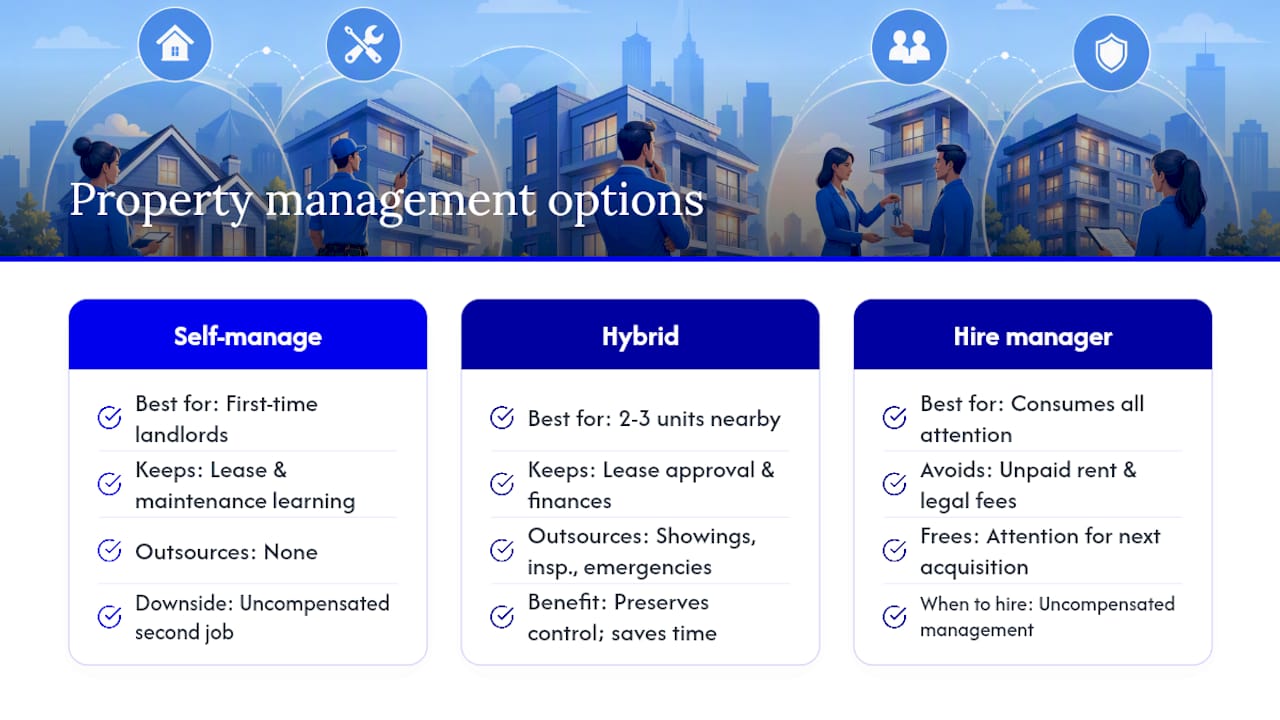
A hybrid approach lets you keep high-level decisions — screening approvals, lease terms, financial reviews — while outsourcing the local, time-consuming work. Showings, emergency vendor coordination, inspections, and tenant calls. For owners with one to four units who are not ready to hand over full control, this is often the most cost-effective starting point. Test it with one property before committing your entire portfolio.

For a broader look at how property management services vary by market and service model, regional owner guides can help you calibrate expectations before you interview candidates.
How much does it cost to hire a property manager?
The monthly management fee is only one line item. Full fee stacks include several components that materially change your all-in cost, and comparing providers on the management percentage alone is a common and expensive mistake.
| Fee Type | Typical Range | What to Watch For |
|---|---|---|
| Monthly management fee | 8%–12% of collected rent | "Of collected" vs. "of scheduled" rent — a key distinction when units are vacant |
| Leasing / placement fee | About 75% of one month's rent | Charged per new tenant; frequency depends on turnover rate |
| Lease renewal fee | $100–$300 flat or 25%–50% of one month | Often overlooked; adds up with stable long-term tenants |
| Maintenance markup | 5%–15% above vendor invoice | Ask whether vendors are in-house or third-party |
| Setup / onboarding fee | up to $500 | One-time; negotiable |
| Eviction coordination fee | $300–$500 plus legal costs | Separate from attorney fees; confirm what is included |
| Late-fee split | around 75% to manager | Some firms keep all late fees as an incentive; others split |
Sample fee calculation
Assume a single-family home renting for $1,800 per month with one tenant turnover per year:
- Monthly management fee at 10%: $180/month × 12 = $2,160/year
- Leasing fee at 75% of one month: $1,350
- Lease renewal (if applicable): $150
- Estimated maintenance markup on $600 in annual repairs at 10%: $60
- Total estimated annual cost: approximately $3,720
Model the full stack before you compare providers.
Fee items to request in writing before signing:
- Written fee schedule covering all transactional fees, not just the monthly rate
- Vendor markup policy and whether the firm uses in-house maintenance staff
- Late-fee split arrangement
- Eviction fee structure, including what triggers the charge and what it covers
- Termination fee and notice period
Red flags include vague "administrative fees," maintenance markups above 15%, and contracts that do not specify disbursement timing for owner funds.
How do you find and vet a property manager?
Finding candidates is the easy part. The National Association of Residential Property Managers (NARPM) maintains a searchable directory by state and city, with member designations that signal professional training. The Institute of Real Estate Management (IREM) offers a similar directory for managers with CPM or ARM credentials. Start there, then run every finalist through the checklist below.
Interview questions that reveal real quality
- What is your current average days on market for vacant units?
- Walk me through your tenant screening process, step by step.
- What is your maintenance response time for emergency vs. non-emergency requests?
- Can I see a sample monthly owner statement?
- What is your vendor selection process, and do you mark up invoices?
- What does your 30-day takeover plan look like for a new property?
- How do owners access their funds and records, and how quickly are disbursements made?
- What is your eviction rate across your current portfolio, and how do you handle the process?
Pro Tip: Ask for measurable performance data — DOM, vacancy rate, and average repair cost per unit — not just references. A manager who cannot produce these numbers after 12 months in business is not tracking what matters.
Reference-check questions
When you speak with a past or current client, ask: How quickly does the manager respond to your calls or emails? Have there ever been discrepancies in your monthly statements, and how were they resolved? Would you re-sign with this firm? The answers to the last two questions are the most revealing.
For a practical guide to choosing a property management partner, the vetting criteria go deeper than credentials alone.
Contract clauses to require
- Scope of work: Every service included must be listed explicitly. Anything not listed is not covered.
- Disbursement timing: When are owner funds released each month? Standard is within 10–15 business days of month-end.
- Vendor spending limit: Require written approval above a set dollar threshold (commonly $300–$500) for non-emergency repairs.
- Termination notice: 30–60 days written notice, with no penalty for cause-based termination.
- Data access: You must retain access to all tenant records, lease files, and financial data if the relationship ends.
- Insurance and indemnity: Confirm the firm carries errors-and-omissions (E&O) and general liability coverage.
Contract red flags: automatic renewal clauses with no opt-out window, termination fees exceeding one month's management fee, and contracts that assign ownership of tenant data to the management company.
Request a 30-day takeover plan
Before signing, ask every finalist to outline what they will do in the first 30 days. A quality firm will describe a property audit, lease review, tenant communication plan, portal setup, and vendor introductions. A vague answer here predicts a vague onboarding.
How do you manage the manager after you hire?
Delegation is not abdication. The owners who get the most from professional management are the ones who set clear performance expectations upfront and review them consistently.
KPIs every owner should track
- Average days on market (DOM): How long vacant units sit before a qualified tenant signs. Under 21 days is strong in most markets.
- Vacancy rate: Target below 5% annually for a stabilized portfolio.
- Rent collection rate: Percentage of scheduled rent collected on time each month. Anything below 95% warrants a conversation.
- Maintenance spend per unit: Track monthly and flag spikes that suggest deferred maintenance or vendor issues.
- Repair turnaround time: Emergency repairs within 24 hours; non-emergency within 3–5 business days.
- Tenant retention rate: High turnover is expensive. Each vacancy costs leasing fees, turnover work, and lost rent.
Reporting cadence
Your manager should deliver a monthly owner statement that includes a rent roll, itemized expenses, maintenance log, and beginning/ending balance. Quarterly, request a KPI summary covering DOM, vacancy, and collection rate. Annually, review the full vendor spend and compare it to market rates.
A practical 6-month monitoring plan:
- Month 1: Confirm portal access, review the first statement, and verify tenant onboarding is complete.
- Month 2: Check DOM on any vacant units and ask for a leasing update.
- Month 3: Review maintenance spend vs. budget and request a property inspection report.
- Month 4: Assess rent collection rate and confirm late-fee handling matches the contract.
- Month 5: Review tenant satisfaction indicators (renewal intentions, complaint volume).
- Month 6: Full KPI review. If two or more metrics are below target, schedule a formal performance conversation with a written improvement plan.
If performance does not improve within 30 days of that conversation, the termination clause you negotiated at signing becomes your exit.
What a high-quality full-service manager should deliver
The difference between an average property management firm and a strong one shows up in the specifics: how fast they respond, how transparent their reporting is, and what they guarantee.
Milwaukeepm (Investment Property Management Pros) illustrates what a full-service offering should look like in practice. Their onboarding sequence runs as follows:
- Week 1: Property audit, lease review, and owner portal setup. Existing tenants receive a formal introduction and new payment instructions.
- Week 2: Vendor roster established with preferred contractors for maintenance, emergency repairs, and unit turnover work.
- Week 3: Any vacant units are listed across marketing channels with professional photography and market-rate pricing.
- Week 4: First owner report issued, covering current occupancy, any open maintenance items, and a 30-day leasing update.
Beyond onboarding, the deliverables owners should expect from a firm at this level include:
- Owner and tenant portals for real-time access to statements, maintenance requests, and lease documents
- A tenant guarantee for the first year, giving owners confidence in the screening and placement process
- Monthly KPI reporting covering vacancy, collection rate, and maintenance spend
- Emergency-response protocol with defined response windows for urgent repairs
- Eviction coordination handled through established legal partners, with the owner kept informed at each stage
- Utilities management and assistance with real estate sales or acquisitions when needed
Milwaukeepm's full-service property management covers tenant marketing, screening, rent collection, maintenance coordination, eviction processing, and detailed monthly reporting — with both owner and tenant portals included.
For owners evaluating how a firm maps to the comparison dimensions that matter most: Milwaukeepm serves residential and commercial portfolios of varying sizes, offers transparent fee structures, and provides the legal and maintenance infrastructure that makes scaling a portfolio manageable rather than chaotic.
An editorial perspective on when hiring actually makes sense
The conventional framing of this decision — "hire when you have too many units to manage yourself" — misses the more important variable: what your time is actually worth and what you are building toward.
Most first-time landlords self-manage their first property, and that is often the right call. You learn how leases work, what maintenance costs, how tenants behave, and what a bad screening decision looks like up close. That education is genuinely valuable and hard to replicate from a distance. The mistake is staying in self-management mode past the point where it serves you.
The owners who hire too late are usually the ones who underestimate how much a single high-risk tenant costs. Not just in unpaid rent or legal fees, but in the months of distraction, the deferred maintenance that piles up during a dispute, and the opportunity cost of not pursuing the next acquisition because this one is consuming all available attention. When managing becomes an uncompensated second job, the question is not whether to hire — it is why you waited.
The hybrid model deserves more credit than it gets. For a two- or three-unit portfolio where the owner lives nearby, keeping lease approval and financial oversight in-house while outsourcing showings, inspections, and emergency calls is often the most rational structure. It preserves control where control matters and delegates where time is the real cost.
One honest caveat: the right answer depends on your local market, your lease terms, and applicable state landlord-tenant law. Adapt any general framework to your specific jurisdiction before acting on it.
Milwaukeepm: full-service management without the guesswork
Owners who have worked through this guide and decided to hire deserve a firm that delivers on the specifics, not just the promise. Milwaukeepm (Investment Property Management Pros) offers full-service residential and commercial property management built around the things that protect your investment: meticulous tenant screening, a first-year tenant guarantee, responsive maintenance coordination, and monthly KPI reporting through a dedicated owner portal.
Three things owners consistently value most: the owner portal gives you real-time access to statements and maintenance logs without waiting for a call back; the local vendor network means repairs get scheduled and completed at competitive rates; and eviction coordination is handled through established legal partners so you are never navigating that process alone. Rent collection runs through the portal, a drop box, or walk-in cash — whichever works for your tenants.
To get started, request a consultation with Milwaukeepm and have your property address, current lease terms, and a rough sense of your monthly rent ready. The team will walk you through service scope, fees, and what onboarding looks like for your specific portfolio.
Sources
Finding the right property manager takes more than a Google search. These resources give you verified directories, legal grounding, and practical how-to guidance.
- National Association of Residential Property Managers
- When to Hire a Property Manager: The Decision Framework | REI Prime
- Hiring a Property Manager: 2026 Landlord's Guide | VerticalRent
- Do You Need to Hire a Property Manager? | BiggerPockets Blog
- Resident manager claims (analysis of employer liability) | Seigel Law
This article is general information, not a substitute for advice from a qualified financial advisor. Consult a qualified financial professional about your own circumstances before acting on anything here.